Stefan Messingschlager
Historian & Political Scientist
with a focus on Modern China & Sino-German Relations
News and Public Outreach

New Publication
10/02/2026
Credit the advice, own the choice: governing expertise in German policymaking
in: Zeitschrift für Politikwissenschaft/ Journal of Political Science, 2 October 2026, ahead-of-print available online: https://doi.org/10.1007/s41358-026-00467-8.
Democratic governments depend on expertise. Yet expert authority becomes fragile when advisory roles remain ill-defined, evidentiary and decision pathways cannot be reconstructed, disagreement is submerged beneath claims of consensus, or democratically accountable decision-makers recast value-laden choices as technical necessities. Treating expert advice as a problem of democratic institutional design, this article develops an expertise-legitimacy chain comprising calibrated advisory pluralism, auditable traceability, structured dissent and the clear attribution of political responsibility. It compares Germany’s 2022 Expert Commission on Gas and Heat, pandemic advisory arrangements and the Council of Experts on Climate Change. The comparison reveals a committee-centred system capable of mobilising scientific, stakeholder and implementation knowledge while sustaining statutory review. Its recurrent weakness lies in rendering the political use of advice publicly accountable. Role designations, proportionate documentation, uncertainty communication, structured dissent, ex post review and reasoned government responses can preserve democratic ownership by showing where expert assessment ends and political choice begins.
New Publication
10/02/2026
Autorität unter Vorbehalt: Akademische Militärexpertise und öffentliche Urteilsbildung
in: Portal für Politikwissenschaft (pw-portal), 2 October 2026
Seit Russlands Vollinvasion der Ukraine ist akademische Militärexpertise zu einer prägenden Instanz öffentlicher Urteilsbildung geworden. Am Beispiel von Sönke Neitzel, Herfried Münkler, Claudia Major und Carlo Masala untersucht Stefan Messingschlager, wie wissenschaftliche Sachkunde unter medialen Bedingungen öffentliche Autorität gewinnt und woran sich deren Qualität bemisst. Der Essay zeigt, dass belastbare Expertise Ungewissheit nicht beseitigt, sondern diszipliniert bearbeitet.
New Publication
09/28/2026
Review of: Thomas Etzemüller: Handgranate oder Zeichenstift. Zur Ambivalenz der Moderne, Hamburg 2025
in: Das Historisch-Politische Buch 74/2 (2026), pp. 387-388.
„Handgranate oder Zeichenstift“ ist ein ebenso souveräner wie eloquenter Essay über die Ambivalenz der Moderne. Indem Etzemüller Social Engineering vom Küchenraum bis zur Raumentwicklung als Versuch liest, soziale Komplexität zu entlasten – ohne autoritäre Seiten zu verharmlosen –, liefert er einen belastbaren Rahmen, um Moderne jenseits monokausaler Moralerzählungen zu verstehen. Die Aktualität liegt auf der Hand: Die Alternative ist nicht bloß Metapher, sondern eine Handlungsaufforderung, den Zeichenstift entschlossen – und lernfähig – in der Hand zu behalten. Eine unbedingte Lektüreempfehlung.
New Publication
09/24/2026
Die Weltmacht China ist vom Ausland abhängig
in: Frankfurter Allgemeine Zeitung (FAZ), 24 September 2026.
New Publication
09/21/2026
Wissenschaft in China: Eine politisch gelenkte Wettbewerbsordnung
in: Forschung & Lehre Online, 21 September 2026.
Seit der russischen Vollinvasion der Ukraine hat sich in Deutschland eine verdichtete Medienarena militärbezogener Deutung herausgebildet. Der Beitrag analysiert akademische Militärexpertise als Sozialfigur der Zeitenwende. Auf Basis eines Korpus aus Talkshows, Interviews, Podcasts und programmatischen Texten der Jahre 2022 bis 2025 zeigt er, dass ihre neue Sichtbarkeit aus einer spezifisch deutschen Konstellation von strategiekulturellem Schock, institutioneller Schwäche und hohem öffentlichen Orientierungsdruck hervorgeht. Öffentliche Autorität stabilisiert sich dabei durch vier Repertoires – Übersetzen, Szenariobildung, Warnen und strategisches Framing –, die zugleich charakteristische Friktionen zwischen Unsicherheit, Prognosezwang, Medienlogiken und politischer Positionierung erzeugen. Der Aufsatz verschiebt damit den Blick von der Bewertung einzelner Prognosen auf die wissenssoziologische Analyse akademischer Militärexpertise und entwickelt daraus Folgerungen für Rollenklarheit, Unsicherheitskommunikation und institutionelle Pluralisierung.
New Publication
09/03/2026
Krieg lesbar machen: Akademische Militärexpertise, öffentliche Autorität und Unsicherheit in der „Zeitenwende“
in: SIRIUS: Zeitschrift für Strategische Studien 10/1-2, pp. 50-72.
Seit der russischen Vollinvasion der Ukraine hat sich in Deutschland eine verdichtete Medienarena militärbezogener Deutung herausgebildet. Der Beitrag analysiert akademische Militärexpertise als Sozialfigur der Zeitenwende. Auf Basis eines Korpus aus Talkshows, Interviews, Podcasts und programmatischen Texten der Jahre 2022 bis 2025 zeigt er, dass ihre neue Sichtbarkeit aus einer spezifisch deutschen Konstellation von strategiekulturellem Schock, institutioneller Schwäche und hohem öffentlichen Orientierungsdruck hervorgeht. Öffentliche Autorität stabilisiert sich dabei durch vier Repertoires – Übersetzen, Szenariobildung, Warnen und strategisches Framing –, die zugleich charakteristische Friktionen zwischen Unsicherheit, Prognosezwang, Medienlogiken und politischer Positionierung erzeugen. Der Aufsatz verschiebt damit den Blick von der Bewertung einzelner Prognosen auf die wissenssoziologische Analyse akademischer Militärexpertise und entwickelt daraus Folgerungen für Rollenklarheit, Unsicherheitskommunikation und institutionelle Pluralisierung.
New Publication
09/01/2026
China-Kompetenz in Deutschland: Reicht unser Wissen aus?
in: Welt.Macht.China [China-Podcast der ARD], 1 September 2026.
China ist Deutschlands wichtigster Handelspartner und ein zentraler geopolitischer Akteur. Gleichzeitig prägt das Land zunehmend politische Debatten, Medienberichte und Diskussionen in den sozialen Netzwerken. Doch wie fundiert ist unser Wissen über China wirklich? Und reicht die vorhandene Expertise aus, um die richtigen politischen und wirtschaftlichen Entscheidungen zu treffen? In dieser Folge spricht Host Joyce Lee mit Ruth Kirchner vom ARD-Hauptstadtstudio Berlin über den Wandel der deutschen China-Politik und die Frage, ob die Beziehungen zu China heute kritischer betrachtet werden als noch vor einigen Jahren. Außerdem diskutiert sie mit dem Politikwissenschaftler Stefan Messingschlager, wie es um das China-Wissen in Deutschland steht, warum China-Kompetenz für Politik, Wirtschaft und Gesellschaft wichtig ist und wie Deutschland im internationalen Vergleich bei der Förderung von China-Expertise aufgestellt ist.
New Publication
08/26/2026
Guardrails, Not Scripts: Historical Analogy, Proximate Precedents, and Crisis Bottlenecks in U.S.–China Rivalry
in: Politische Vierteljahresschreift/ German Political Science Quarterly, 26 August 2026, pp. 1-17.
Debates on U.S.–China rivalry often overburden historical analogies: The same comparison is expected to diagnose the structure of rivalry, explain the dynamics of a bounded crisis, and prescribe institutions of restraint. This research note develops a mechanism-sensitive heuristic for avoiding that conflation. It argues that historical comparison becomes analytically productive when analogies are sorted by task and when crisis bottlenecks, rather than entire eras, are treated as the portable unit of transfer. Structural analogies illuminate the background stakes of rivalry; process analogies reconstruct the mechanisms through which bounded crises intensify; design analogies identify institutional devices that may interrupt those mechanisms. Two refinements follow. First, the most portable unit of transfer is usually not an era as a whole but a crisis bottleneck at which time, interpretation, and political room for manoeuvre contract. Second, when the object is a concrete crisis rather than rivalry in the abstract, proximate precedents should normally take priority over grand analogies because they preserve more of the present case’s dyadic, theatre-specific, operational, and political-symbolic features. The argument is demonstrated through the 2001 collision and detention crisis involving a United States Navy EP-3 reconnaissance aircraft. Read in this way, the most defensible historical lessons for U.S.–China rivalry are procedural rather than prophetic: Effective guardrails buy time, clarify signals, and provide face-saving exits.
New Publication
08/17/2026
Ideologie als Infrastruktur: Re-Ideologisierung und digitaler Autoritarismus unter Xi Jinping
in: Jahrbuch Politisches Denken 35 (2025-2026), pp. 31-60.
New Publication
08/13/2026
Eine Infrastruktur für China-Kompetenz
in: Table-Forum China-Kompetenz, 13 August 2026.
Der Erfolg des Netzwerks bemisst sich weder an der Größe seiner Geschäftsstelle noch an der Zahl seiner Produkte. Entscheidend ist, ob Institutionen schneller passende Expertise finden, Infrastrukturen ineinandergreifen und weniger sichtbare Fachprofile zum Zuge kommen. Eine gute Infrastruktur tritt hinter ihrer Wirkung zurück: Sie macht nicht sich selbst sichtbar, sondern andere handlungsfähig. Aus vielen leistungsfähigen Orten einen belastbaren Zusammenhang zu schaffen, ohne ihre Eigenständigkeit anzutasten – darin liegt der Gründungsauftrag.
New Publication
08/07/2026
How China Is Reordering Global Governance From Within
in: The Diplomat, 7 August 2026. [together with Helene Bode]
Beijing’s June white paper leaves the U.N.-centered architecture intact – but re-interprets the priorities.
New Publication
07/25/2026
Früher gab es noch Zukunft im Überschuss
in: DIE ZEIT/ ZEIT am Wochenende, Issue 30/ 2026, 25 July 2026.
In China träumen junge Menschen von einer Zeit vor dem Internet. Der Trend: Rückzug und Verweigerung. Ist das schon Regimekritik? Die Realität ist komplizierter.
New Publication
07/24/2026
Hinter dem Einwegspiegel: Chinaforschung unter Sicherheitsvorbehalt – und die Kunst disziplinierter Unvollständigkeit
in: Kölner China-Studien Online 01/2026, 19 pp.
Der Essay untersucht die veränderten Erkenntnisbedingungen historischer und sozialwissenschaftlicher Chinaforschung. Er argumentiert, dass China nicht einfach in eine „Blackbox“ zurückkehrt, sondern in einer Quellenordnung selektiver Sichtbarkeit erscheint. Die Volksrepublik produziert weiterhin eine Fülle von Daten, Normen, digitalen Spuren, Korpora und staatlichen Selbstbeschreibungen; deren Entstehung, Kuratierung, Zugänglichkeit und mögliche Löschbarkeit werden jedoch stärker durch Sicherheitslogiken, regulatorische Unschärfe und institutionelle Vorsicht geprägt. Daraus entsteht eine doppelte Staatszentrierung: Chinesische Schließungsdynamiken und westliche Risikoperspektiven privilegieren strategisch auswertbares Wissen, während lokale Vermittlungen, gesellschaftliche Erfahrung und die „mittlere Auflösung“ alltäglicher Herrschaft schwerer beobachtbar werden. An Beispielen aus Statistik, Gerichtsdaten, Feldzugang und digitalen Methoden zeigt der Beitrag, weshalb Datenfülle keine Transparenz garantiert. Er plädiert für disziplinierte Unvollständigkeit: präzise Quellenkritik, transparente Markierung von Unsicherheit und Urteile, die nicht mehr Gewissheit beanspruchen, als die Evidenz trägt.
New Publication
07/18/2026
Conditional Access and Epistemic Resilience in European China Studies,
in: Journal of the European Association for Chinese Studies, vol. 7.1 (2026), pp. 85–98.
This article argues that European China Studies is moving from an era in which access to the People’s Republic of China was widely treated as “normal” to a “post-access” condition in which field sites, archives, databases, and partnerships are increasingly governed as revocable permissions. Rather than treating access constraints as episodic misfortunes, I conceptualise them as a mode of governance that produces patterned missingness, redistributes risk onto interlocutors and early-career scholars, and shapes what kinds of claims can be made responsibly. The post-access condition is compounded by Europe’s own turn towards research security and by a synthetic information environment that shifts the burden from finding data to verifying provenance. Against this background, the essay develops the notion of epistemic resilience: the capacity of a research community to sustain critical, empirically grounded knowledge under uncertainty without confusing duty of care with intellectual timidity. Epistemic resilience requires plural data ecologies for triangulation, transparent “access-and-constraint statements” that render absences comparable, and verification routines for digital evidence, including provenance and authenticity checks appropriate to generative media.
New Publication
06/30/2026
Review of Sugata Bose: Asia after Europe: Imagining a Continent in the Long Twentieth Century, Cambridge, MA/ London 2024
in: Global Intellectual History 11/5 (2026), pp. 658-661.
"Asia after Europe is a landmark contribution to transnational intellectual history. Combining intellectual, cultural, and political history, it not only enriches our understanding of Asia’s past but also offers a compelling framework for rethinking its future. By weaving together the region’s intellectual and political trajectories with global developments, Bose underscores the continued relevance of Asia’s legacies in addressing contemporary global challenges. His work stands as both a scholarly intervention and an invitation to further engage with the region’s rich intellectual and political traditions."
New Publication
06/29/2026
When the Evidence Base on China Becomes a Policy Risk
in: China Observers in Central and Eastern Europe (CHOICE), 29 June 2026.
Europe’s China policy now rests on a widening evidentiary contradiction. The EU wants to de-risk China-related supply chains, screen investments, enforce export controls, protect research cooperation, and manage exposure to economic coercion. Yet these tools depend on reliable evidence about China at the very moment when that evidence base is becoming more selective, unstable, costly, and legally uncertain. China is not becoming unknowable. The problem is specific: Europe has to make policy under conditions of curated access.
New Publication
06/29/2026
Rule-Setting After Primacy: America’s Networked Realism at 250
in: E-International Relations, 29 June 2026.
America’s 250th anniversary should not invite nostalgia for lost primacy. The more useful question is harsher and less ceremonial: can a domestically divided republic still set the rules under which others trade, connect, compute and resist coercion? The semiquincentennial is therefore less a civic festival than a strategic audit. It asks whether the United States can still turn power into rules that others regard as legitimate enough to accept, costly enough to make defiance unattractive, and durable enough to survive electoral cycles. That distinction matters. A state can possess formidable capabilities and still fail to organise order. It can spend heavily on defence while lacking the diplomatic trust, industrial resilience and domestic steadiness required for long competition. Conversely, a state that occupies central positions in security, finance, technology and standards networks can multiply its influence through partners. The central test for the United States is not a simple referendum on primacy or decline. It is a conversion test: can American power still structure the networks through which others innovate, trade, deter coercion and define acceptable conduct?
New Publication
06/27/2026
Mit Peking reden, Brüssel stärken
in: wochentaz, 27 June 2026, p. 15.
Deutschland braucht China. Belastbar wird ein Dialog aber erst, wenn Berlin ihn europäisch absichert: mit Regeln und eigener industrieller Stärke.
New Publication
06/24/2026
Stabilität auf fremde Rechnung: Was die neue Trump-Xi-Formel für Europa bedeutet
in: Blätter für deutsche und internationale Politik 7/2026, pp. 89-96.
Donald Trump und Xi Jinping sprechen von strategischer Stabilität. Doch gemeint ist keine neue Kooperation zwischen den USA und China, sondern die vorläufige Einhegung ihrer Rivalität. Für Europa kann diese bilaterale Stabilisierung kurzfristig Entlastung bringen – langfristig aber droht sie Europas Abhängigkeiten zu zementieren und seine politische Gestaltungsmacht zu untergraben.
New Publication
06/24/2026
Jervis Forum Review 186: Messingschlager on Dikötter, Red Dawn Over China
in: H-Diplo | Robert Jervis International Security Studies Forum, Review 186, 24 June 2026.
Frank Dikötter’s Red Dawn Over China begins with dust, not destiny. “Time grinds everything into dust,” he writes (xii), framing a preface about archival survival, political forgetting, and the later construction of revolutionary origins. As a chronological prelude to his People’s Trilogy, the book extends Dikötter’s long-standing concern with violence, ideology, and archival recovery back into the formative decades of CCP power. It then poses a stark question: how did a Chinese Communist Party (CCP) that was often marginal, faction-ridden, and hunted nevertheless seize state power in 1949? Dikötter’s answer is anti-romantic.
New Publication
06/04/2026
Warum Deutschland China-Kompetenz dauerhaft finanzieren muss
in: Research.Table Professional Briefing no. 381, 04 June 2026.
Deutschland hat begonnen, China-Kompetenz als strategische Querschnittsaufgabe ernst zu nehmen. Doch befristete Projektförderung gefährdet den Aufbau dieses Wissens. Dauerhafte Strukturen sind nötig.
New Publication
06/01/2026
Atemräume unter Vorbehalt: Diskursinfrastruktur und Loyalitätsregime: Intellektuelle in der Xi-Ära
in: MERKUR: Deutsche Zeitschrift für europäisches Denken, 80/ 925 (June 2026), pp. 5-19.
New Publication
05/27/2026
Why Germany must fund China expertise for the long term
in: China.Table no. 1336, 27 May 2026.
Germany has begun to take China expertise seriously as a strategic cross-cutting task. But short-term project funding is putting the development of that knowledge at risk. What is needed are permanent structures.
New Publication
05/27/2026
Warum Deutschland China-Kompetenz dauerhaft finanzieren muss
in: China.Table no. 1336, 27 May 2026.
Deutschland hat begonnen, China-Kompetenz als strategische Querschnittsaufgabe ernst zu nehmen. Doch befristete Projektförderung gefährdet den Aufbau dieses Wissens. Dauerhafte Strukturen sind nötig.
New Publication
05/08/2026
Europe’s Left and China: Beyond Campism and Atlanticism
in: The Diplomat, 8 May 2026. [together with Arnau Brasó Ibáñez]
The European left can make Europe’s China policy more socially intelligent. But leftists must not forget that Chinese society is more than the Chinese state.
New Publication
05/07/2026
Selective Legalism and China’s Ordercraft: How Beijing Mobilizes Law while Resisting Binding Verdicts
in: Yale Journal of International Affairs 21/2 (Spring 2026), ahead-of-print available online.
In contemporary diplomacy, “international law” and the “rules-based international order” travel as portable slogans. Yet their political work differs. The phrase “rules-based” can obscure the question that matters most in practice: who gets to say what the rules mean, and what follows when they are breached? China’s recent diplomacy highlights a growing contest not over whether legality exists, but over where legality is produced—in courts, councils, arbitral panels, or bargaining tables. That institutional choice has distributional effects: verdicts can constrain and sometimes equalize, while process-centered bargaining often amplifies power asymmetries.
This article advances a simple claim: China increasingly practices selective legalism. I use the term as shorthand for a recurring pattern: embracing treaty-based rules and legal vocabulary while steering disputes away from venues that can issue binding decisions. The effect is a reallocation of legal authority—from adjudication toward managed negotiation and mediation-centered venue-making. I use ordercraft to denote deliberate efforts to shape the procedural defaults and institutional venues through which legal authority is produced and made consequential. In legal terms, it preserves obligation while restricting delegation.
Selective legalism is neither simple “hypocrisy” nor a wholesale rejection of international law. It is closer to what Robert Williams, a legal scholar at Yale Law School and nonresident senior fellow at the Brookings Institution, calls a flexible and functional approach: law as a tool of legitimation and delegitimation, deployed to shape the context of choice. What is new is how systematically Beijing couples legal vocabulary to procedural engineering.
New Publication
05/05/2026
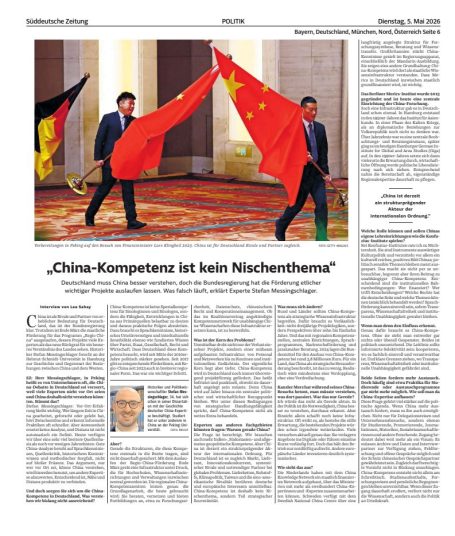
"China-Kompetenz ist kein Nischenthema"
in: Süddeutsche Zeitung, 5 May 2026, p. 6. [Interview with Lea Sahay, Peking]
Deutschland muss China besser verstehen, doch die Bundesregierung hat die Förderung etlicher wichtiger Projekte auslaufen lassen. Was falsch läuft, erklärt Experte Stefan Messingschlager.
New Publication
04/29/2026
Book Review: La credibilidad de Europa en el Indopacífico entre la estrategia y la percepción regional
in: Revista CIDOB d’Afers Internacionals, no. 142, p. 210-213. [together with María Herrero Martínez]
Book review:
Abbondanza, Gabriele y Grgić, Gorana. Europe’s Indo-Pacific pivot: navigating new horizons. Palgrave Macmillan, 2025, 149 págs.
Joshi, Yogesh, Nishida, Ippeita y Chaturvedi, Devyani (eds.). The European Union as a security actor in the Indo-Pacific: perceptions and responses from the region. Palgrave Macmillan, 2024, 221 págs.
New Publication
04/28/2026
Court Day, not Liberation Day: option-value statecraft and the volatility premium of U.S. transactionalism in Trump’s second term
in: Australian Journal of International Affairs, ahead-of-print available online: DOI: 10.1080/10357718.2026.2665618.
On 20 February 2026, the U.S. Supreme Court held that the International Emergency Economic Powers Act (IEEPA) does not authorise the President to impose tariffs. On the same day, the White House terminated IEEPA duties, maintained the suspension of de minimis treatment, and invoked Section 122 of the Trade Act of 1974 to impose a 10% import surcharge for 150 days. It is tempting to read the ruling as the end of Trump’s ‘Liberation Day’ regime. This essay argues the opposite. Court Day was less a reset than a shock that exposed Trump’s second-term governing logic. Tariffs, market access, and alliance reassurance operate as policy options: instruments whose value lies not only in the pressure imposed, but in the right to reprice, suspend, and reissue that pressure under changing legal and diplomatic forms. I call this option-value statecraft. Operationally, it is visible in rapid statutory substitution, built-in reversibility, and the monetisation of predictability. The result is a volatility premium that allies and rivals pay through litigation risk, deferred investment, supply-chain duplication, and insurance politics among middle powers. For Australia, the task is transaction-proofing: hardening commitments where possible, pricing U.S. policy volatility into planning, and building alternatives without rupture.
New Publication
04/28/2026
Review of Ilker Gündoğan: The Politics of Football in China: Institutional Change and Political Steering Under Xi Jinping (2025)
in: ASIEN: The German Journal on Contemporary Asia 172/173 (2024), pp. 181-183.
"With this impressive analytical achievement, The Politics of Football in China constitutes a substantial contribution to contemporary scholarship on China, authoritarian governance, and globalised sports politics. The book is thus highly recommended to scholars specialising in China and governance studies, as well as practitioners and policymakers interested in understanding the complex political dynamics shaping global sporting arenas."
New Publication
04/24/2026
Review of Marc Matten/ Egas Moniz Bandeira: Globalgeschichten aus China: Aktuelle Debatten in der Volksrepublik (2023)
in: Comparativ: Zeitschrift für Globalgeschichte und vergleichende Gesellschaftsforschung, 1/2 (2026), pp. 192-196.
"Globalgeschichten aus China is essential reading for anyone interested in global history, historiographical debates, or the role of non-Western perspectives in reshaping our understanding of the past. By fostering dialogue, methodological innovation, and a commitment to multiperspectival analysis, the volume sets the stage for future scholarship that fully embraces the complexities of global interconnectivity. It challenges existing paradigms while offering a vision for a more inclusive and equitable global historiography, positioning Chinese perspectives as a vital component of the discipline’s evolution."
New Publication
04/16/2026
The Iran War and the Indo-Pacific Cost of Selective Legality
in: E-International Relations, 16 April 2026.
The test posed by the Iran war is not Tehran’s character, it is in whether governments still believe that law binds friends as well as enemies.
New Publication
03/27/2026
Solidarity as Strategy: China’s ‘True Multilateralism’ and the Solitude of Rules
in: Oxford Political Review, 27 March 2026.
Chinese diplomacy goes hand in hand with the language of solidarity. Through the idioms of ‘true multilateralism’, the ‘democratisation of international relations’, and the promise of a ‘community with a shared future for mankind’, Beijing offers many governments a dignified way to resist world hierarchy. But this goes only so far. A meticulously reasoned 2016 South China Sea arbitral award was dismissed as ‘null and void’; the Sino–British Joint Declaration on Hong Kong, registered with the UN and promising a ‘high degree of autonomy’, is increasingly portrayed, in Beijing’s telling, as a mere ‘historical document’ already spent. And so, the paradox is clear: China’s solidarity lexicon travels well, while the rules themselves too often stand alone – affirmed in principle, yet set aside when they constrain.
New Publication
03/12/2026
China und der Iran: Macht? Gern. Verantwortung? Lieber nicht.
in: Die ZEIT, 12 March 2026.
Außenpolitik bedeutet für China: Einfluss ohne Bündnisbindung und Nähe ohne Schutzgarantie. Das zeigt der Krieg gegen den Iran gerade deutlich.
New Publication
02/24/2026
Scale Is Not a System: Learning from China without Mimicry
in: Made in China Journal, Volume 10, Issue 2, 2025, pp. 64-73.
Kaiser Kuo’s (2025) ‘The Great Reckoning: What the West Should Learn from China’ is a bracing provocation. He argues that China is no longer merely ‘catching up’ but increasingly sets the tempo of economic, technological, and institutional development. Legitimacy in the twenty-first century, he contends, rests increasingly—though not exclusively—on performance, with climate policy as the decisive test: China is simultaneously the largest carbon dioxide emitter and the indispensable builder of clean energy, installing more solar and wind capacity each year than the rest of the world. The United States is already edging towards instruments it once disdained, such as industrial policy and state–private sector coordination, even as public discourse clings to reassuring rationalisations. Drawing on Joseph Levenson’s (1965) meum/verum distinction, Kuo diagnoses a widening gap between what Western societies hold dear and what the world renders true. His call is not a policy manual but a perceptual shift: to acknowledge achievement clearly rather than coping by predicting collapse.
The question, then, is not whether a reckoning is due—it surely is—but how to reckon well. A persuasive response must integrate what Kuo sees and what his sweeping lens blurs: the historical depth of multiple modernities, the cyclical fragility of performance-based legitimacy, the difference between a toolbox and an order, the gap between capacity and system integration, and the terms by which learning travels between regimes.
In this piece, I advance five claims. First, modernity has long been plural, and China radicalises that plurality by pushing it to continental scale. Second, performance-based legitimacy is powerful yet cyclical and depends on truth-tracking inputs. Third, scale is not system: enduring gains hinge on integration, not capacity totals. Fourth, convergence of instruments such as subsidies and procurement does not equal convergence of orders defined by accountability and reversibility. Fifth, learning travels between regimes under constraints that determine what can be adopted and how fast.
The aim of this reply is to sharpen, not blunt, Kuo’s challenge: to recognise what is genuinely new about China’s ascent while resisting the temptation to infer a wholesale hierarchy of systems from a hierarchy of outcomes in particular domains.
New Publication
02/23/2026
Durchs Dickicht der Geopolitik,
in: Süddeutsche Zeitung, 23 February 2026, p. 13.
Volker Perthes betrachtet die viel beklagte Multipolarisierung als Prozess, der regional unterschiedliche Auswirkungen hat und auch Chancen eröffnet.
New Publication
02/13/2026
Trump’s Taiwan Gamble: How U.S. Transactionalism Reshapes Beijing’s Risk Calculus,
in: Columbia Journal of International Affairs, 13 February 2026.
Since January 2025, Washington has increasingly treated economic and security commitments to Taiwan as renegotiable bargains. This article argues that such “transactional deterrence” can strengthen near-term denial—via accelerated arms transfers and industrial mobilization—while injecting volatility into punishment credibility and crisis management. Beijing’s late-2025 coercive rehearsal and sanctions preparation suggest that probing pressure, under shorter decision cycles, is now the central escalation risk.
New Publication
01/16/2026
Europa im Spiegel Pekings,
in: Frankfurter Allgemeine Zeitung, 16 January 2026.
[guest op-ed together with Arthur Tarnowski]
Wie China Europas „strategische Autonomie“ für sich reklamiert. Und was daraus folgt.
New Publication
01/09/2026
Ein Krieg in den Köpfen,
in: DIE ZEIT, 9 January 2026.
Die Entführung Maduros zeigt, wie sensibel Deutungshoheiten sind. In Taiwan spüren sie: Gewalt lässt sich politisch als Vollzug erzählen. China weiß das zu nutzen.
New Publication
01/08/2026
Review of: David Shambaugh: Breaking the Engagement: How China Won & Lost America
in: International Affairs 102/1 (2026), pp. 313-315.
"[...] the book represents a significant scholarly contribution, offering an analytically rigorous account of the rise, internal contradictions and eventual collapse of America's long-standing engagement policy toward China."